The Question Nobody Googles
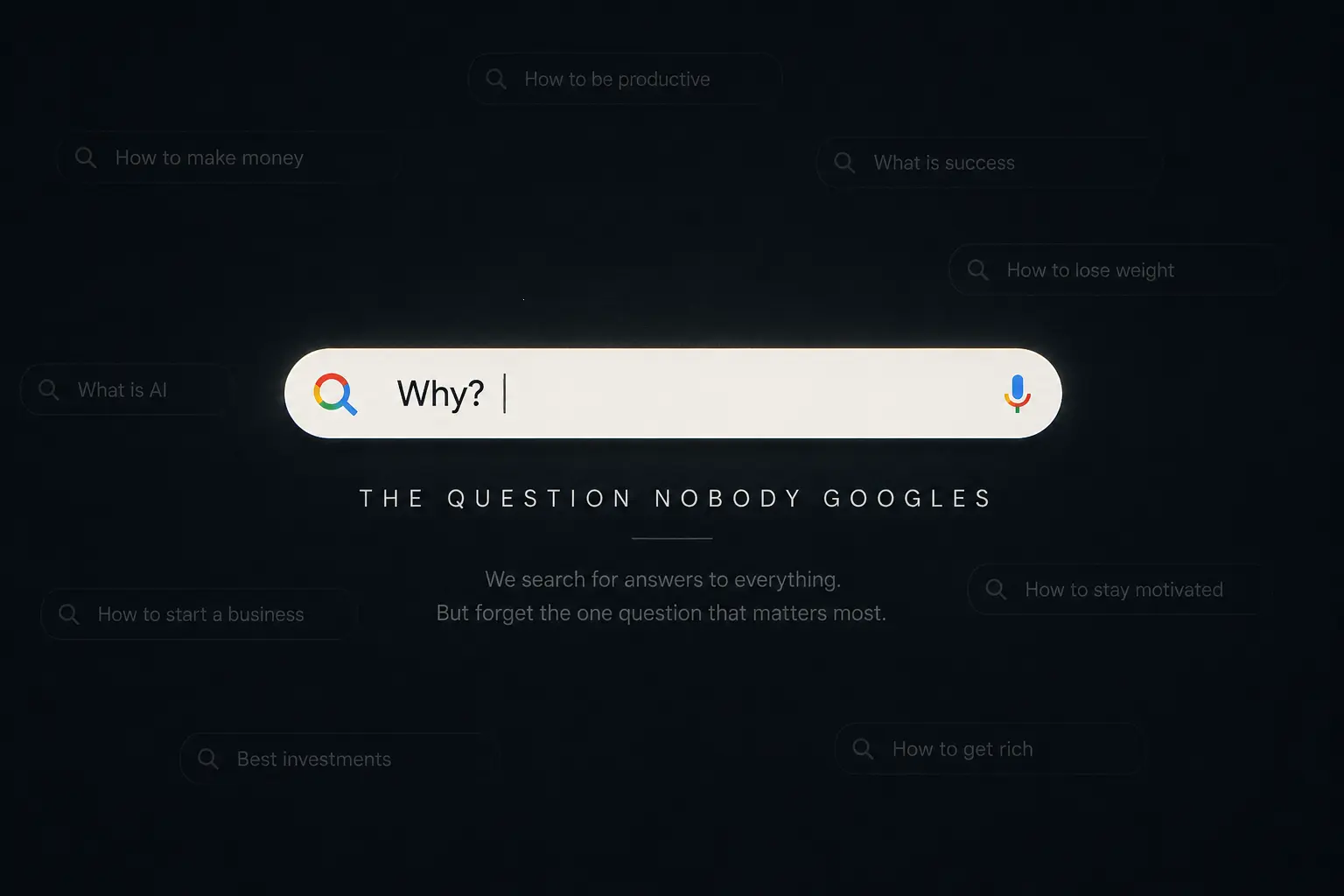 Each passing day, billions of people type into that tiny search box on Google. Some are looking for solutions. Some want information. And some, though they may not admit it, are searching for comfort.
A student in class 12th is asking “How can I learn to code?” A person struggling with their body asks “How to lose weight?” An entrepreneur building a quick commerce brand is asking “How many people buy groceries from supermarkets?” And somewhere, quietly at 2 AM, a heartbroken guy is typing “Why did she leave me?”
At surface level, everything seems normal. But the internet is a strange and revealing place. People ask questions here that they would never ask another human being. And when you analyse billions of such queries over a decade, a pattern emerges.
I used Google Trends to analyse how many people are using “What”, “How” and “Why” in their search queries. I wanted to see the data of the last 10 years around the globe. And the following data emerged.
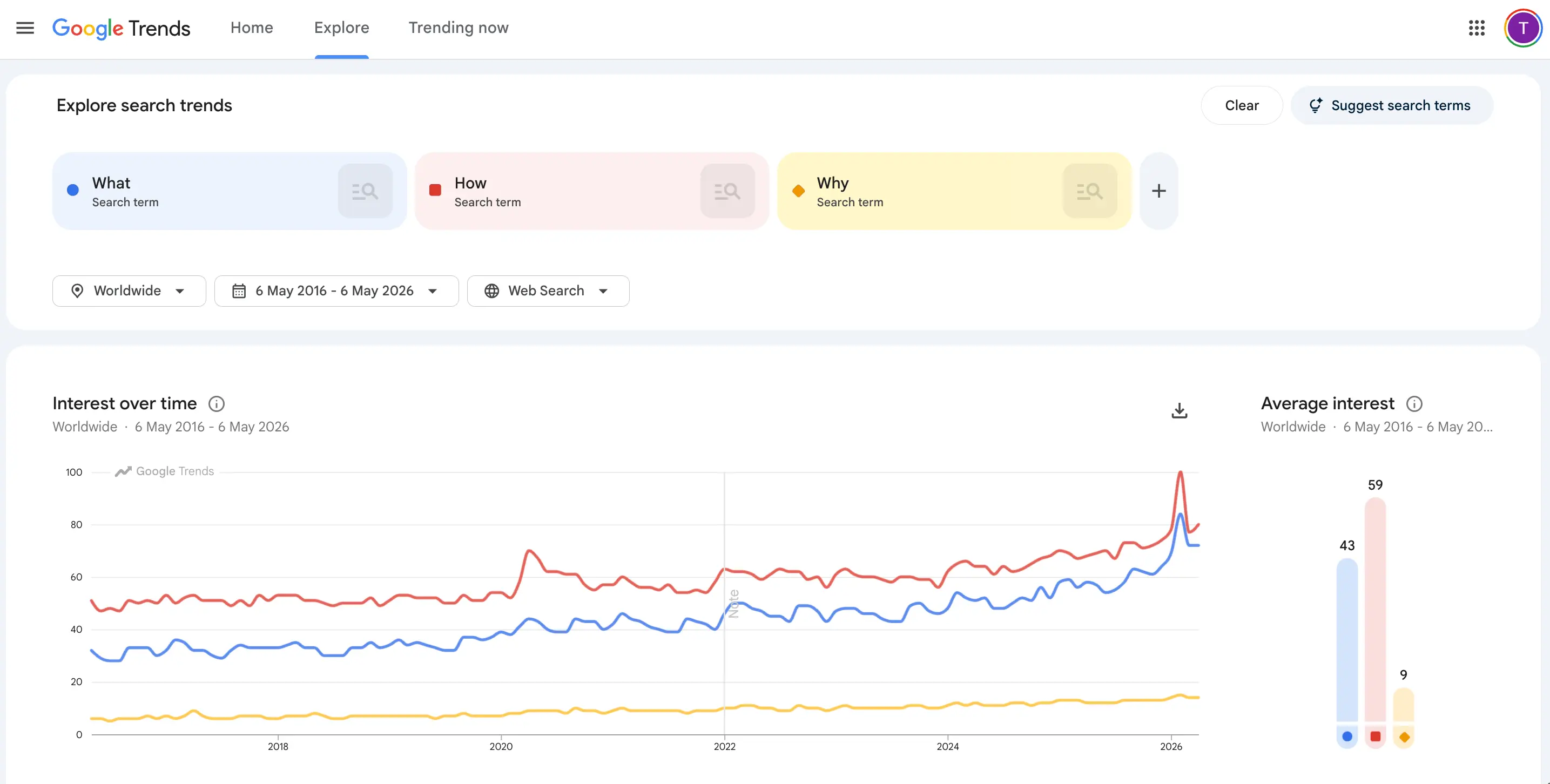
Most of the queries have “How” in them. And a bit less, but still a huge number of people are using “What” in their searches. Compared to this, far fewer people are interested in the “Why” behind something.
The most interesting fact: the gap between “What” and “How” remains relatively stable over the last 10 years. But when we compare that to “Why”, the gap is significantly increasing.
And somewhere, I understand that. We are in a world that is rapidly evolving and asking “What” and “How” is more relevant to understand and make sense of information. “What” helps us understand the world. “How” helps us operate within it.
Modern society is extraordinarily good at answering the first two. Schools teach us what to think. The internet teaches us how to act. But very few spaces ever ask the harder question: why are we living the way we are?
The dominance of “how” is not accidental. We live in an age that has turned self-improvement into an obsession. Whether it is about productivity, money, fitness, relationships, attention — even happiness itself has become something to optimise. The implicit promise is always the same: find the right method, and your life will work.
And in many ways, this is remarkable. A person sitting in a small town with a smartphone can now access knowledge that once belonged only to elite universities and powerful institutions. The speed at which we learn, move, and do is unmatched by any previous era in human history.
But something strange is also happening beneath this endless search for methods.
People are learning how to achieve things faster than ever before, while becoming increasingly unsure about why they wanted those things in the first place.
Let me show you this in my own life.
After having a look at this data, I wanted to see if it was anywhere close to my own search patterns. So I went to my search history and noticed that it took me a long while to find a “Why” query in a pool of “What” queries.
On the other side, when I look at my day, I find myself asking a lot of “Why” questions. Why do I have to go to the office? Why am I here in this world? Why can’t I finish what I started?
Most of these questions are inquisitive and related to my personal identity and core beliefs. Thinking more about it, I realised people ask “Why” when they are in the toughest situations of their lives. When someone close to us dies, when we are laid off from a job, when we are in an accident.
We are no strangers to such situations. And we all know how many times we ourselves, or people around us, have asked “Why.” Because “Why” helps us survive it — emotionally.
“What” and “How” ask about the world. “Why” asks about you.
It does not reach for information. It reaches into identity. It surfaces things that are uncomfortable to look at: inherited beliefs, unexamined fears, desires borrowed from other people’s lives.
As children, we asked “why” constantly and almost compulsively. But slowly, quietly, that instinct gets trained out of us. Schools reward answers more than reflection. Workplaces reward execution more than contemplation. Social media rewards speed more than depth.
A person asking “how” fits comfortably into modern systems. A person asking “why” may begin questioning the system itself.
And that is not a comfortable place to be.
A life lived entirely inside “how” and “what” is a life lived on the surface. Efficient, optimised — but also quietly empty. The person who has never asked why often cannot name what they actually want, separate from what they were told to want. They keep achieving. They keep moving. But something underneath stays restless, unnamed.
We humans have become extraordinarily skilled at building the external world. We know more than ever before. We can do more than ever before. Yet many people still find themselves quietly disconnected. From themselves, from others, from any sense of why any of it matters.
In the end, the internet could not answer the heartbroken person’s question. Not really. Because “Why did she leave me?” was never a question about her. It was a question about him. A question about worth, about identity, about what he believed he deserved.
A person may spend a decade learning how to become successful and still feel hollow when they get there.
This kind of “why” cannot be searched. It has to be sat with.
And maybe this is the quietest crisis of modern life. Not that we lack information, but that we have built an entire civilisation that is not sitting with itself long enough to ask the one question that actually matters most.
We may not always start with why. But we must never stop asking it.